
If you are planning to launch an ecommerce business, one of the first questions you will probably ask is: how much does a Shopify store cost?
The short answer is that you can technically start a Shopify store for around $29 per month when the Basic plan is billed annually. But that is only the platform subscription.
A real Shopify business may also need a domain, apps, a theme, payment processing, product samples, fulfillment, advertising, email marketing, and other tools.
For a beginner, a realistic Shopify store may cost $30 to $100+ per month before advertising and product costs. A growing brand can easily spend $200 to $1,000+ per month, depending on its apps, design, payment volume, marketing, and fulfillment model.
The good news is that you do not need to pay for everything from day one.
This guide breaks down the real cost of running a Shopify store in 2026 and shows you where you can save money without making your store look cheap or unprofessional.
Pricing note: Shopify prices in this guide were checked in August 2026. Shopify pricing, payment fees, taxes, promotions, and local pricing may vary by country.
How Much Does a Shopify Store Cost in 2026?
The first expense is your Shopify subscription.
For US pricing, Shopify currently lists the following rates when paying annually:
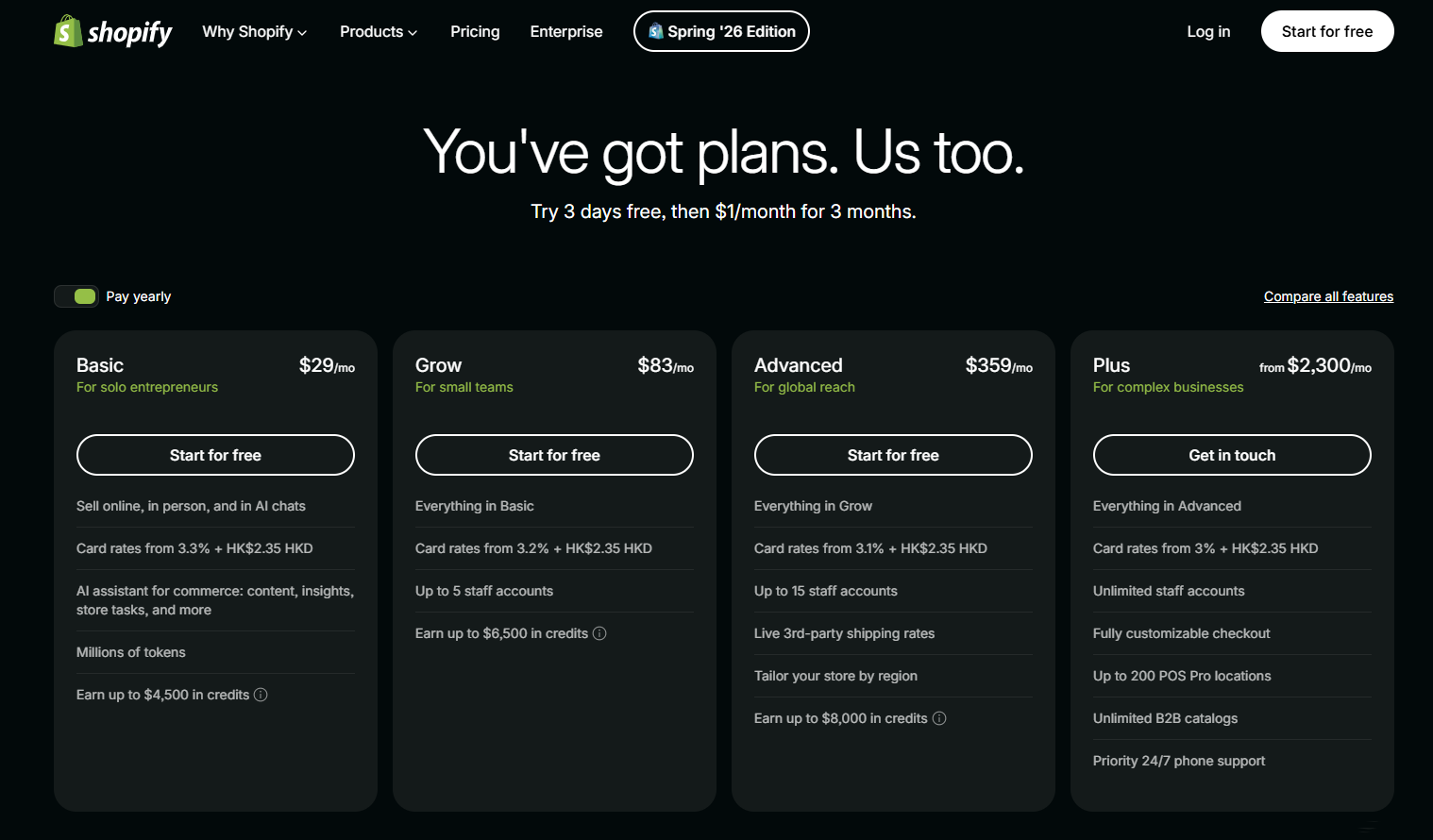
Shopify's official pricing page currently lists Basic at $29 per month, Grow at $83 per month, and Advanced at $359 per month when billed annually.
For most people starting their first ecommerce business, Basic is enough.
It includes the core tools needed to build and operate an online store. Shopify also includes hosting and an SSL certificate, which means you do not need to buy a separate web hosting plan as you would with many self-hosted ecommerce platforms.
What Shopify Costs Are Included in Your Subscription?
One advantage of Shopify is that many technical costs are already bundled into the platform.
Your subscription generally covers:
- Ecommerce hosting
- Store builder
- Product management
- Shopping cart
- Checkout
- SSL certificate
- Inventory management
- Order management
- Analytics
- Discount codes
- Customer accounts
- Basic marketing tools
- Access to Shopify apps
- Access to free Shopify themes
Shopify confirms that its plans include unlimited web hosting and a free SSL certificate.
That matters because comparing Shopify only with the hosting price of another platform can be misleading.
With another ecommerce setup, you may separately pay for hosting, security, backups, checkout software, plugins, maintenance, and development.
Shopify combines many of those functions into one subscription.
How Much Does a Shopify Domain Cost?
Every Shopify store receives a free myshopify.com subdomain.
For example: yourbrand.myshopify.com
You can build and test your store with this address, but most serious businesses should use a custom domain.
Something like:
yourbrand.com
looks much more professional.
According to Shopify's 2026 domain pricing guide, custom domains commonly cost around $10 to $30 per year, although the final price depends on the domain extension and availability. Domains purchased through Shopify are registered for one year and can be renewed annually.
That makes the monthly equivalent very small.
For example:
$20 domain ÷ 12 months = about $1.67 per month
You can also buy your domain from another registrar and connect it to Shopify.
Should You Buy a Domain Immediately?
Yes, if you plan to launch publicly.
A custom domain can improve:
- Brand credibility
- Customer trust
- Email professionalism
- Brand recognition
- Link sharing
- Long-term SEO consistency
However, you do not need to buy several domains when validating a new business idea.
One strong .com domain is usually enough.
Suggested screenshot: Shopify Admin → Settings → Domains.
How Much Does a Shopify Theme Cost?
Your next potential expense is store design.
Shopify provides free themes, so paying for a theme is optional.
The official Shopify Theme Store currently includes free themes as well as paid options. Current paid themes include examples priced around $100, $150, $350, $400, $420, and even $500.
That means there are three common approaches.
1. Use a Free Shopify Theme
Cost: $0
This is often the smartest option for a new store.
A clean free theme with strong product images and clear product pages can perform better than an expensive theme filled with unnecessary animations.
Use a free theme when you are still validating:
- Your niche
- Product-market fit
- Pricing
- Advertising
- Target audience
- Conversion rate
Do not spend $400 on design before you know whether customers actually want your product.
2. Buy a Premium Shopify Theme
Typical cost: around $100–$500 as a one-time purchase
Premium themes often include additional features such as:
- Mega menus
- Product filters
- Quick views
- Product badges
- Sticky add-to-cart sections
- Advanced promotional sections
- Color swatches
- Enhanced product galleries
- Countdown timers
- Built-in cross-selling sections
A premium theme can sometimes replace several paid apps.
This is important.
A $400 theme that removes the need for three $15-per-month apps can potentially save money over the long term.
3. Build a Custom Shopify Store
Custom development can cost anywhere from several thousand dollars upward.
Shopify notes that custom themes can cost $5,000+, while more complex projects may cost significantly more depending on requirements.
A completely custom store usually makes sense only after the business already has sales, customer data, and clear conversion requirements.
For a beginner, it is normally unnecessary.
How Much Do Shopify Apps Cost?
Apps are one of the most underestimated Shopify expenses.
A merchant may start with one app.
Then another.
Then another.
Soon, a $29 Shopify subscription has become a $150 monthly software stack.
Shopify apps can charge in several ways:
- Free
- Free plan with paid upgrades
- Monthly subscription
- One-time payment
- Usage-based fees
Shopify confirms that apps may have recurring, one-time, or usage-based charges, and their billing cycles can be separate from the Shopify subscription itself.
Common app categories include:
|
App Type |
Possible Monthly Budget |
|
Reviews |
$0–$30+ |
|
Email marketing |
$0–$100+ |
|
Upsells |
$0–$50+ |
|
SEO |
$0–$30+ |
|
Page builders |
$0–$50+ |
|
Customer support |
$0–$100+ |
|
Subscriptions |
$0–$100+ |
|
Bundles |
$0–$30+ |
|
Tracking |
$0–$30+ |
|
Loyalty programs |
$0–$100+ |
You do not need all of these when you launch.
How to Keep Shopify App Costs Under Control
Before installing an app, ask three questions:
Does Shopify already provide this feature?
Shopify has added many native features over time. You may not need an app.
Will this app increase revenue or reduce meaningful work?
If it does neither, reconsider it.
Can one app replace several other apps?
Consolidating tools can reduce both cost and store complexity.
A good beginner target is:
$0–$30 per month in apps.
Upgrade your software stack when sales justify the expense.
How Much Does Shopify Charge Per Sale?
This is where Shopify costs become more complicated.
Your monthly subscription is a fixed expense.
Payment processing is a variable expense.
For US merchants using standard online card payments, Shopify's current published rates start at:
|
Plan |
Standard Online Card Rate |
|
Basic |
2.9% + $0.30 |
|
Grow |
2.7% + $0.30 |
|
Advanced |
2.5% + $0.30 |
Shopify also publishes different rates for premium cards, international cards, PayPal Wallet, in-person transactions, and other payment methods. Actual rates can depend on market and payment type.
Consider a simple example.
Suppose your average order value is $50 and you process 100 orders.
Your monthly revenue is:
100 × $50 = $5,000
Using the Basic standard online rate as a simplified example:
Percentage fee:
$5,000 × 2.9% = $145
Fixed transaction component:
100 × $0.30 = $30
Estimated processing cost:
$175
This is separate from product cost, shipping, advertising, refunds, and other operating expenses.
What Happens If You Use a Third-Party Payment Provider?
Additional Shopify transaction fees may apply when merchants use certain third-party payment providers instead of Shopify Payments.
Shopify currently publishes:
- Basic: 2%
- Grow: 1%
- Advanced: 0.6%
- Plus: 0.2%
This can become important for high-volume sellers.
For example, a 1% difference on $50,000 of monthly transactions is:
$50,000 × 1% = $500
At scale, payment structure can matter much more than whether an app costs $10 or $20 per month.
How Do You Know When to Upgrade Your Shopify Plan?
Do not upgrade just because the more expensive plan looks more professional.
Upgrade because the numbers or features support it.
For example, annual billing currently makes Grow approximately $50 per month more expensive than Basic:
$79 − $29 = $50.
The difference between their listed standard online card rates is approximately 0.2 percentage points.
If payment-rate savings were the only consideration:
$50 ÷ 0.002 = $25,000
At roughly $25,000 in monthly eligible card volume, the difference in percentage processing costs could theoretically offset the $50 plan-price difference.
This is only a simplified example. Real payment costs vary by card type, payment method, country, taxes, refunds, and other factors.
The real reason to upgrade may instead be access to:
- Staff accounts
- Better reporting
- Shipping features
- International selling tools
- Lower transaction fees
- Operational capabilities
Use your actual store numbers rather than upgrading based on revenue alone.
How Much Does a Shopify Dropshipping Store Cost?
Dropshipping changes the Shopify cost structure significantly.
In a traditional ecommerce model, you might buy:
- $3,000 of products
- $2,000 of products
- Or even $10,000+ of inventory
before knowing whether customers will buy them.
Dropshipping can reduce that upfront inventory requirement because products are typically purchased after a customer places an order.
That can make the answer to how much does a Shopify store cost very different for a dropshipper compared with a traditional retailer.
A simple dropshipping setup could include:
|
Expense |
Estimated Cost |
|
Shopify Basic |
$29/month annually billed |
|
Domain |
$10–$30/year |
|
Theme |
$0 |
|
Essential apps |
$0–$30/month |
|
Dropshipping platform |
Potentially $0 |
|
Product samples |
$50–$200 |
|
Advertising |
Depends on strategy |
|
Product & shipping cost |
Paid as orders occur |
One way to reduce fixed startup costs is to work with a fulfillment platform that does not require a large monthly software commitment.
How CJdropshipping Can Reduce Shopify Startup Costs
CJdropshipping can connect with Shopify and help merchants source products, list products, synchronize orders, and manage fulfillment.
CJ's current documentation states that general platform functions such as store authorization, product listing, and order synchronization do not require a platform usage fee. Its Free membership is currently listed at $0 per month, while optional paid membership levels and value-added services are also available.
This means a beginner does not necessarily need another large monthly dropshipping software subscription simply to start connecting products and processing orders.
Instead, the major variable costs normally come from:
- Product cost
- Shipping
- Optional custom packaging
- Private inventory
- Photography or video services
- Certain warehousing or fulfillment services
- Other optional value-added services
CJ also provides product sourcing, Shopify integration, order synchronization, quality inspection options, and global fulfillment capabilities.
For beginners, this creates an important distinction:
You can keep fixed software costs relatively low while paying product and fulfillment costs as the business generates orders.
That can make testing products less capital-intensive.
How Much Money Do You Really Need to Start a Shopify Store?
There is a difference between the minimum technical cost and a realistic launch budget.
You could technically create a Shopify store with:
- Basic plan
- Free theme
- Custom domain
- Free apps
- Dropshipping fulfillment
and spend relatively little.
But launching a business also involves testing.
Here are three realistic scenarios.
What Does a Lean Shopify Startup Budget Look Like?
Best for:
- First-time entrepreneurs
- Dropshippers
- Product testing
- Organic traffic strategies
Possible startup budget:
|
Expense |
Budget |
|
Shopify |
$29 |
|
Domain |
$10–$30/year |
|
Theme |
$0 |
|
Apps |
$0–$20 |
|
Product samples |
$50–$150 |
|
Logo/design |
$0–$50 |
|
Initial content |
DIY |
|
Initial paid traffic |
Optional |
|
Core starting budget |
Roughly $100–$300 before significant advertising |
The goal at this stage is not to build the world's most beautiful ecommerce site.
The goal is to answer:
Will people buy this product?
What Does a $1,000 Shopify Budget Look Like?
A $1,000 budget gives you more room to test properly.
One example allocation could be:
|
Item |
Budget |
|
Shopify + domain |
$50 |
|
Theme |
$0 |
|
Apps |
$20 |
|
Product samples |
$100 |
|
Product photos/content |
$80 |
|
Ad testing |
$600 |
|
Emergency/testing reserve |
$150 |
|
Total |
$1,000 |
Notice that the largest part of this budget is not spent on the website.
It is spent on learning whether customers will buy.
That is deliberate.
A common beginner mistake is spending:
- $400 on a theme
- $200 on a logo
- $200 on apps
- $200 on animations
and then having no money left to test customer acquisition.
Your first store does not need to win a design award.
It needs to convert traffic into sales.
What Does a Growing Shopify Store Cost?
Once you have validated products and consistent sales, spending more can make sense.
A growing store could look like this:
|
Expense |
Monthly Equivalent |
|
Grow plan |
$79 |
|
Domain |
~$2 |
|
Premium theme amortized over 12 months |
~$30 |
|
Apps |
$50–$150 |
|
Email/SMS |
$20–$200+ |
|
Support tools |
$0–$100+ |
|
Creative tools |
$0–$100+ |
|
Development |
Variable |
|
Product/fulfillment |
Variable |
|
Advertising |
Variable |
A reasonable software and platform budget could therefore reach approximately:
$150–$500+ per month
before advertising, products, and fulfillment.
That is not necessarily bad.
Software becomes expensive only when it costs more than the value it creates.
A $50 upsell tool that creates $1,000 in additional profit is cheap.
A $9 app nobody uses is expensive.
What Shopify Costs Do Beginners Often Forget?
When asking how much does a Shopify store cost, many entrepreneurs only count Shopify itself.
Several additional expenses can appear later.
Product Samples
Never rely completely on supplier images or specifications.
Order samples when possible.
Check:
- Product quality
- Packaging
- Shipping time
- Product dimensions
- Color accuracy
- Instructions
- Customer experience
For dropshipping sellers, sample orders are part of product research.
Returns and Refunds
Not every order becomes permanent revenue.
Your financial model should include an allowance for:
- Refunds
- Returns
- Replacements
- Lost parcels
- Damaged products
- Customer service recovery
If you calculate profit without these expenses, your projected margin will look better than reality.
Content Creation
Good ecommerce stores need content.
That may include:
- Product photography
- UGC
- Short-form video
- Product descriptions
- Blog posts
- Ad creatives
- Landing pages
You can create some of this yourself, but it still requires time.
Email and SMS Marketing
Email software may start free but become more expensive as your list grows.
Instead of looking only at the entry price, check how costs change at:
- 1,000 subscribers
- 5,000 subscribers
- 10,000 subscribers
- 50,000 subscribers
Growth can change your software economics.
Development
Small code changes can eventually become a recurring expense.
Examples include:
- Custom sections
- Tracking fixes
- Page-speed optimization
- App conflicts
- Conversion improvements
- Advanced integrations
Avoid custom development until there is a measurable business reason for it.
How Should You Calculate the True Cost of a Shopify Store?
Use two categories.
Fixed Monthly Costs
These stay relatively stable regardless of the number of orders.
Fixed costs = Shopify + apps + domain + theme allocation + recurring services
Example:
Shopify: $29
Apps: $20
Domain allocation: $2
Theme: $0
Total:
$51 per month
Variable Costs
These increase when you make more sales.
A simplified formula is:
Variable cost per order = product + shipping + payment fee + advertising cost + packaging + expected return/refund cost
Your real profit calculation becomes:
Net profit = Revenue − product cost − shipping − payment fees − advertising − refunds − software − other operating costs − applicable taxes
This calculation is far more useful than asking whether Shopify costs $29 or $39 per month.
The Shopify subscription may actually become one of your smallest expenses once the business starts scaling.
How Can You Reduce Shopify Costs Without Hurting Sales?
Cutting expenses is useful.
Cutting expenses that generate profitable sales is not.
Use these strategies instead.
1. Start With Basic
Most new stores do not immediately need Grow or Advanced.
Start with the lowest plan that supports your operation.
Upgrade when your sales volume, staff needs, transaction economics, or features justify it.
2. Pay Annually Once the Business Is Validated
Shopify's published annual billing rates are lower than its monthly rates for Basic, Grow, and Advanced.
But there is no need to make a longer commitment before you are confident in your business idea.
Validate first.
Then optimize recurring costs.
3. Start With a Free Theme
A premium theme does not automatically produce better conversion rates.
Product-market fit matters more.
So do:
- Clear offers
- Good images
- Competitive pricing
- Fast pages
- Strong reviews
- Easy checkout
- Trustworthy shipping information
Upgrade the theme when you know exactly which features you need.
4. Review Your Apps Every Month
Create a simple spreadsheet.
Include:
|
App |
Monthly Cost |
Used? |
Revenue Impact |
Keep? |
|
App A |
$15 |
Yes |
High |
Yes |
|
App B |
$20 |
Rarely |
Unknown |
Review |
|
App C |
$9 |
No |
None |
Remove |
Ten unnecessary $10 apps equal:
$100 per month
or:
$1,200 per year
App audits are one of the easiest ways to improve ecommerce profitability.
5. Avoid Large Inventory Before Validation
Buying inventory can reduce per-unit cost.
It can also create risk.
Before ordering large quantities, validate:
- Demand
- Conversion rate
- Customer acquisition cost
- Refund rate
- Product quality
- Shipping performance
A dropshipping model using a provider such as CJdropshipping can help test products without committing the same amount of capital to bulk inventory upfront.
Once a product has predictable sales, you can then evaluate private inventory, custom packaging, branding, or overseas warehouse strategies.
6. Watch Cost Per Order, Not Just Monthly Fees
Suppose Tool A costs $20 per month.
That sounds cheap.
But if it also charges $1 per order and you process 3,000 orders, the real monthly cost is:
$3,020
Always review:
- Monthly charges
- Usage fees
- Transaction fees
- Order fees
- Contact limits
- Email limits
- Percentage-based fees
The cheapest-looking plan is not always the cheapest plan.
How Much Should Marketing Add to Your Shopify Budget?
Marketing is technically separate from the cost of Shopify, but it is part of the real cost of running the business.
There is no universal minimum advertising budget.
You can acquire traffic through:
- SEO
- TikTok
- YouTube
- Influencer marketing
- Affiliate marketing
- Communities
- Meta Ads
- Google Ads
Organic strategies require less advertising cash but more time.
Paid advertising gives you faster data but requires capital.
For product testing, the important number is not simply your advertising budget.
It is your customer acquisition cost, or CAC.
If you spend $500 and generate 20 new customers:
CAC = $500 ÷ 20 = $25
If your contribution margin before advertising is only $18, the campaign is losing money.
That information is more useful than saying "$500 is a good advertising budget."
How Much Does a Shopify Store Cost Per Month in Practice?
We can now give a better answer.
Beginner Dropshipping Store
Approximately:
$30–$100+ per month before advertising and order-related costs
Possible setup:
- Shopify Basic
- Custom domain
- Free theme
- A few free or low-cost apps
- CJdropshipping for sourcing and fulfillment
- DIY content
Growing Ecommerce Store
Approximately:
$150–$500+ per month before advertising and product costs
Possible setup:
- Shopify Grow
- Premium theme
- Several paid apps
- Email marketing tools
- Customer support tools
- Analytics
- Occasional development
Established Ecommerce Brand
Approximately:
$500–$2,000+ per month in platform/software costs
This could include:
- Advanced Shopify
- Premium apps
- Advanced reporting
- Development
- Marketing automation
- Customer support systems
- International tools
- Custom functionality
Large businesses using Shopify Plus can spend significantly more.
The correct answer to how much does a Shopify store cost therefore depends much more on your business stage than on Shopify's advertised starting price.
What Is the Smartest Shopify Budget for Beginners?
Do not start by asking:
“How expensive should my store look?”
Start by asking:
“What is the minimum system I need to test whether customers want my products?”
A smart early-stage setup is often:
- Shopify Basic.
- One custom domain.
- A free theme.
- Only essential apps.
- Three to ten carefully selected products.
- Product samples before scaling.
- Clear shipping and refund information.
- Reliable fulfillment.
- A simple analytics setup.
- Enough budget left to acquire traffic and test offers.
Once sales come in, use the data to decide what to upgrade.
This approach gives you more flexibility and reduces the amount of capital trapped in tools or inventory before the business has proven itself.
Is Shopify Worth the Cost?
For many ecommerce businesses, Shopify's biggest advantage is not that it is the absolute cheapest way to create a website.
It is that many ecommerce functions are already integrated.
You receive hosting, ecommerce infrastructure, checkout, product management, payment integrations, analytics, apps, themes, and order management in one ecosystem.
That can reduce technical complexity.
But Shopify is only worth the cost when the economics of your business work.
Before launching, know these numbers:
- Selling price
- Product cost
- Shipping cost
- Payment processing fee
- Average advertising cost per customer
- Return/refund rate
- Average order value
- Conversion rate
- Monthly software cost
- Gross margin
- Net profit
A store generating $50,000 per month with strong margins should not worry excessively about a useful $30 app.
A store generating no sales should not spend $500 per month on apps.
Match your technology costs to your business stage.
How to Start a Lower-Cost Shopify Dropshipping Store
If your goal is to test an ecommerce idea without buying large amounts of inventory, dropshipping can help reduce your upfront capital requirements.
A simple workflow is:
Step 1: Create your Shopify store.
Start with Basic unless your business requirements justify another plan.
Step 2: Choose a simple theme.
Use a free theme first.
Focus on product presentation rather than unnecessary visual effects.
Step 3: Connect your supplier and fulfillment system.
You can connect your Shopify store with CJdropshipping to source products, list them to your store, synchronize orders, and arrange fulfillment.
CJ's platform currently offers a Free plan at $0 per month for basic features including product listing, store authorization, order monitoring, sourcing requests, and other core functions. Optional paid plans and additional services are available for merchants who need more capabilities.
Step 4: Order samples.
Evaluate quality yourself.
Do not scale a product you have never inspected when samples are practical.
Step 5: Build conversion-focused product pages.
Include:
- Clear product benefits
- Product specifications
- High-quality images
- Shipping information
- Returns information
- Frequently asked questions
- Reviews when genuine customer reviews become available
Step 6: Start with controlled traffic tests.
Do not spread your budget across ten different channels.
Test one or two customer acquisition channels and measure the results.
Step 7: Scale only after the numbers work.
Then consider:
- Premium themes
- Paid apps
- Custom packaging
- Private inventory
- Faster fulfillment
- Overseas warehousing
- Larger advertising campaigns
This creates a much healthier cost structure than paying for every advanced feature before your first sale.
Final Thoughts
So, how much does a Shopify store cost?
For a beginner, the platform itself can start at $29 per month with annual billing, but a realistic ecommerce budget needs to consider much more than the subscription.
Your real Shopify cost includes:
Shopify subscription + domain + apps + theme + payment fees + products + fulfillment + marketing + operating expenses.
The best strategy is not to build the cheapest possible store.
It is to keep fixed costs low until you find products and marketing channels that work.
Start with the essentials.
Validate demand.
Track every cost.
Then invest in better design, automation, branding, inventory, and fulfillment when your sales data gives you a reason to do so.
For dropshipping sellers, platforms such as CJdropshipping can make this process more flexible by connecting product sourcing and fulfillment directly with your ecommerce workflow, allowing you to focus more of your early budget on testing products, acquiring customers, and building a profitable store.
FAQ
How Much Does Shopify Cost Per Month?
Shopify's current US pricing starts at $29 per month for Basic when billed annually, while the monthly billing rate is $39. Grow is $79 per month annually billed, and Advanced is $299 per month annually billed. Additional costs can include domains, apps, themes, payment processing, marketing, products, and fulfillment.
How Much Does It Cost to Start a Shopify Store?
A lean Shopify store can realistically start with approximately $100 to $300 in basic setup expenses before significant advertising. This can include Shopify Basic, a domain, free theme, basic apps, and product samples. Your actual startup budget will depend heavily on your products and customer acquisition strategy.
What Is the Cheapest Way to Start a Shopify Store?
Use Shopify Basic, a free theme, one custom domain, and only essential apps. If you are dropshipping, using a fulfillment solution with no required basic monthly platform fee can also reduce fixed startup costs. CJdropshipping currently offers a $0 Free membership for its basic platform features.
How Much Does Shopify Take From Each Sale?
The exact amount depends on your plan, payment method, country, and card type. For standard US online card payments, Shopify currently publishes starting rates of 2.9% + $0.30 for Basic, 2.7% + $0.30 for Grow, and 2.5% + $0.30 for Advanced. Other payment types can have different rates.
How Much Does a Shopify Dropshipping Store Cost?
A basic dropshipping store may cost roughly $30 to $100+ per month in fixed platform and software expenses before advertising, product costs, and shipping. Using free themes, limiting paid apps, and working with a platform such as CJdropshipping can help reduce fixed startup expenses.
How Can CJdropshipping Help Reduce Shopify Startup Costs?
CJdropshipping provides Shopify integration, product sourcing, product listing, order synchronization, and fulfillment services. Its basic Free membership is currently $0 per month, so sellers can avoid adding another mandatory monthly platform subscription during early product testing. Product costs, shipping, optional memberships, and certain value-added services are charged separately when applicable.