
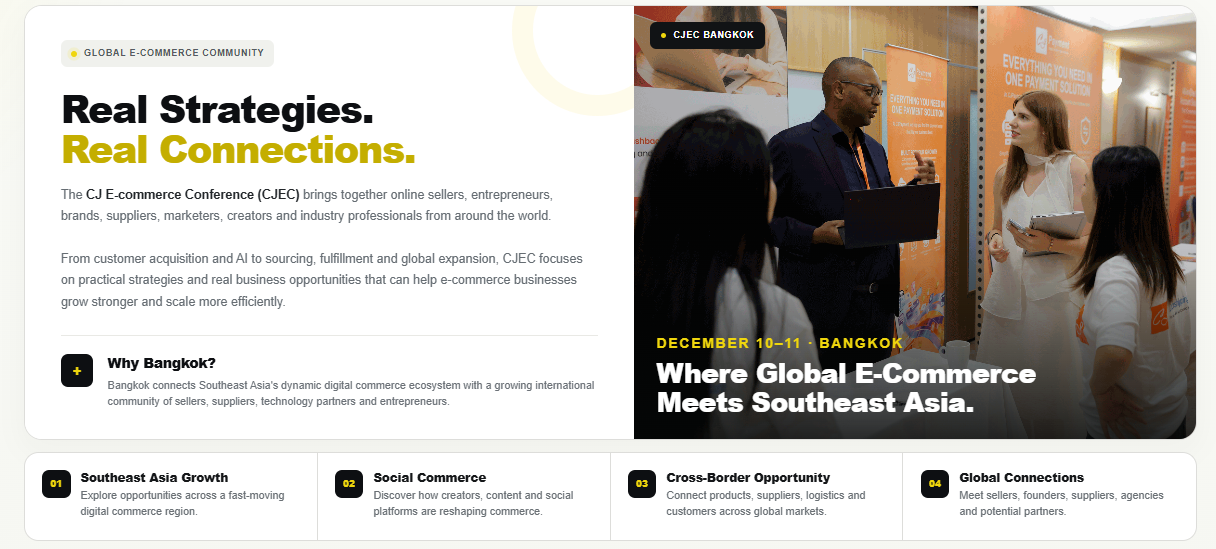
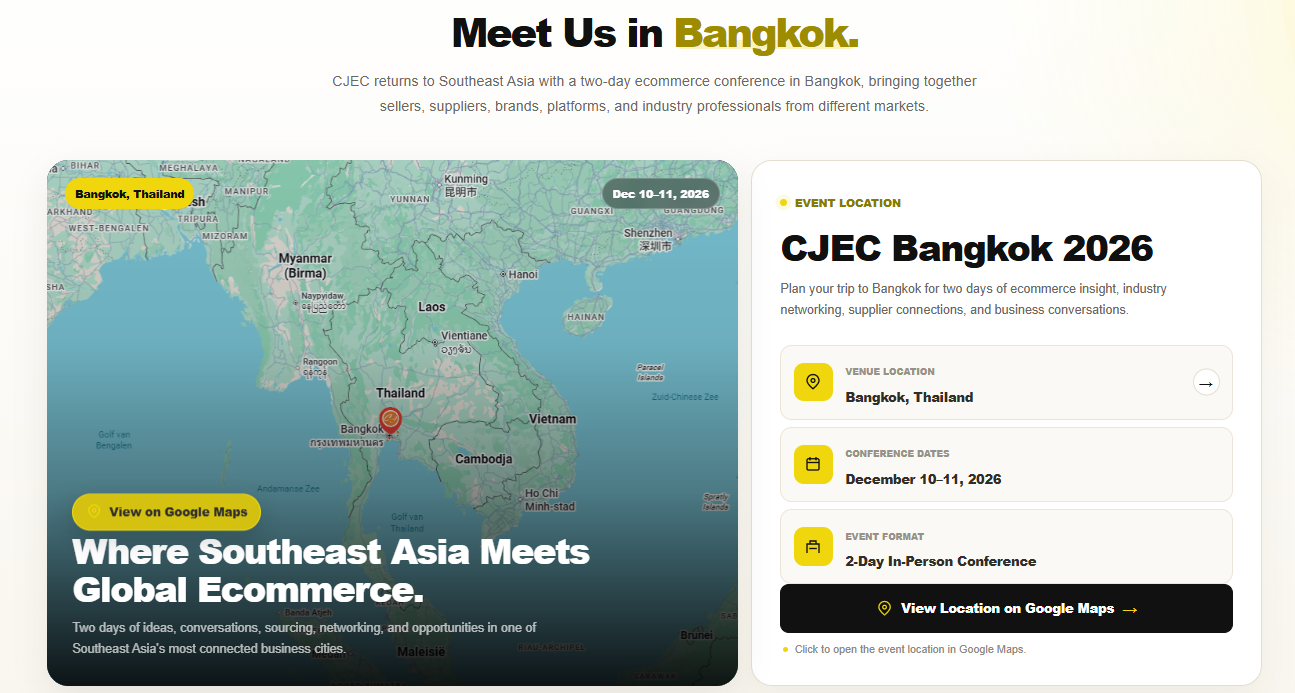
December 10–11, 2026 | Bangkok, Thailand
E-commerce is becoming more global, but growth does not look the same in every market.
Customer behavior changes from country to country. Platforms rise at different speeds. Social commerce is reshaping how people discover products. AI is changing how sellers research, create, advertise, support customers and operate their businesses.
And Southeast Asia is becoming an increasingly important part of that conversation.
That is why we are bringing the CJ E-commerce Conference to Bangkok on December 10–11, 2026.
For two days, CJEC Bangkok 2026 will bring together e-commerce sellers, entrepreneurs, brands, suppliers, manufacturers, marketers, creators, technology companies and industry partners to explore the next stage of global e-commerce growth.
Our goal is simple.
We want people to come for practical ideas, but leave with more than notes.
We want them to leave with new connections, stronger sourcing opportunities, useful strategies, potential partnerships and a clearer understanding of where e-commerce is heading next.
Connect. Learn. Scale. Go Global.
That is what CJEC Bangkok is about.
CJEC Bangkok 2026 at a Glance
| Event Information | Details |
|---|---|
| Event | CJ E-commerce Conference Bangkok 2026 |
| Dates | December 10–11, 2026 |
| Location | Bangkok, Thailand |
| Format | Two-Day In-Person E-Commerce Conference |
| 1-Day Pass | $49 USD |
| 2-Day Pass | $69 USD |
| Guest Offer | Buy 1 Ticket, Bring 1 Guest Free |
| 1-Day Meal | Lunch or Dinner Included |
| 2-Day Meals | Lunch and Dinner Included |
| Focus | E-Commerce, AI, Marketing, Sourcing, Fulfillment, Networking and Global Growth |
Attendees can choose either December 10 or December 11 with the 1-Day Pass, or attend the complete two-day experience with the 2-Day Pass. Card and PayPal payments are currently available through the official event page.
https://cjec.cjdropshipping.com/bangkok-2026/
Why We Chose Bangkok
Every CJEC destination tells a different part of the global e-commerce story.
Guangzhou connects sellers directly with China's sourcing and manufacturing ecosystem.
Antwerp creates conversations around Europe, logistics and cross-border commerce.
Belgrade opens another perspective on European expansion and emerging regional opportunities.
Bangkok brings us into the heart of Southeast Asia's fast-moving digital commerce ecosystem.
The official CJEC Bangkok program is built around four opportunities in particular: Southeast Asia growth, social commerce, cross-border opportunity and global connections.
That combination matters.
Southeast Asia is not simply another destination where international brands can copy the same strategy they use elsewhere.
It is a diverse region.
Customers behave differently.
Content matters differently.
Marketplaces play an important role.
Creators increasingly influence product discovery.
Local payments, logistics, languages and customer expectations can vary from one market to another.
That makes Bangkok a useful place to ask a bigger question:
How should an e-commerce business grow when commerce is becoming more regional, more social and more connected at the same time?
That is the conversation we want to have at CJEC Bangkok.
Thailand's Electronic Transactions Development Agency, or ETDA, maintains dedicated surveys tracking both the country's e-commerce value and internet-user behavior, reflecting how important digital commerce has become to the local economy.
What Is CJEC?
The CJ E-commerce Conference, or CJEC, is our global meeting point for people building, operating and supporting e-commerce businesses.
We bring together online sellers, dropshipping entrepreneurs, brands, suppliers, manufacturers, marketers, creators, platforms, technology companies and service providers.
Across the wider CJEC community, attendees come from more than 60 countries and more than 80 business categories, with participation from leading platforms and industry professionals.
But numbers are not the most important part.
For us, the value of CJEC comes from bringing different parts of e-commerce into the same room.
A seller may need a supplier.
A supplier may need international customers.
A growing brand may need better fulfillment.
A technology company may need merchants.
An agency may need brands.
A founder may need a different perspective.
When the right people meet, a conference becomes much more than presentations.
That is why we describe CJEC Bangkok as more than a conference.
AI for E-Commerce: From Tool to Business System
One of the major CJEC Bangkok topics is AI for Ecommerce.
By 2026, asking whether e-commerce companies should use AI is no longer the most useful question.
Most sellers already have access to AI.
The real question is:
Where can AI create meaningful business value?
At CJEC Bangkok, we will explore how AI is affecting product research, marketing, customer support, operations, content creation and everyday decision-making.
For example, AI may help a seller analyze a large product catalog more quickly.
It may support creative ideation.
It can help structure customer-service workflows.
It can reduce repetitive operational tasks.
It can help teams organize data and compare opportunities.
But AI does not remove the need for strategy.
Generating more content does not automatically produce better marketing.
Analyzing more products does not automatically reveal a winning product.
Automating support does not automatically create a good customer experience.
We want the AI conversation in Bangkok to focus on how technology fits into a real business system, not simply which new tool is popular this month.
Paid Advertising and Customer Acquisition
Getting traffic remains one of the hardest parts of e-commerce.
But traffic alone is not enough.
Businesses need customers they can acquire at a cost that still leaves room for profit.
CJEC Bangkok will examine paid advertising and customer acquisition, including advertising platforms, creatives, targeting, testing and campaign optimization.
This matters because customer acquisition has become more complex.
A customer might first see a short video.
Then visit a marketplace.
Search for reviews.
See another advertisement.
Visit the brand's website.
And finally purchase days later.
That means sellers need to think beyond individual ads.
They need to understand the complete customer journey.
What message creates attention?
Which creative makes someone stop scrolling?
What makes the offer believable?
What happens after someone clicks?
Does the landing page match the advertisement?
Can the store convert the traffic profitably?
And after the first sale, can the business bring that customer back?
Customer acquisition works best when marketing, product, pricing, conversion and retention work together.
Winning Product Discovery
Almost every e-commerce seller wants to find a winning product.
But a winning product is not simply something receiving millions of views on social media.
CJEC Bangkok's product discussions focus on identifying demand, evaluating opportunities, validating ideas and building stronger product pipelines.
We believe sellers should ask more questions before scaling a product.
Is there clear customer demand?
What problem does it solve?
How competitive is the market?
What is the realistic selling price?
What are the shipping costs?
Can supply remain stable?
Does the product have high return risk?
Can it support good content?
Is there room for customization?
Could it become part of a larger brand?
Product selection is not about guessing correctly every time.
It is about building a process that makes bad decisions cheaper and good decisions easier to scale.
Global Sourcing: Beyond Finding a Supplier
Product research and sourcing cannot be separated.
A promising product with the wrong supplier can quickly become an operational problem.
That is why Global Sourcing is another key topic in Bangkok.
The conference will explore supplier selection, pricing, communication, sourcing efficiency, product development and quality-control considerations.
For beginners, sourcing often means finding someone who can ship a product.
As a business grows, that definition changes.
Now you may care about production consistency.
Inventory availability.
Packaging.
Customization.
Lead times.
Negotiation.
Quality control.
Backup suppliers.
And whether the supplier can support higher order volume.
The supplier relationship should grow with the business.
CJEC Bangkok will also include supplier connections and business matching, giving attendees an opportunity to explore potential product and sourcing partnerships directly.
Fulfillment and Logistics: What Happens After the Sale
A successful ad creates an order.
Fulfillment determines what the customer experiences next.
CJEC Bangkok's Fulfillment & Logistics sessions will explore shipping, inventory, fulfillment operations and cross-border logistics.
This is particularly important for international sellers.
Selling to more countries can increase revenue, but it also increases complexity.
Products may need different shipping routes.
Customers may have different delivery expectations.
Some products may make sense for direct fulfillment.
Others may justify local inventory.
Growing brands may eventually need regional warehouses or third-party logistics.
There is no single fulfillment strategy that works for every business.
The right structure depends on volume, destination, product size, margins and customer expectations.
We want attendees to understand fulfillment as part of growth strategy, not simply a cost that happens after checkout.
From Product Testing to Brand Growth
CJEC Bangkok also looks beyond short-term selling.
One of our major conference topics is Brand Growth.
The official program focuses on how e-commerce businesses can move beyond short-term product testing and develop stronger positioning, customer experiences and long-term growth systems.
This transition is especially relevant to dropshipping entrepreneurs.
Dropshipping can be an effective way to test demand.
You do not need to purchase large quantities of inventory before knowing whether customers want the product.
But once a product proves itself, the strategy can change.
You may improve packaging.
Strengthen product quality.
Develop better creative.
Build bundles.
Create repeat-purchase offers.
Improve customer service.
Invest in retention.
Develop private-label versions.
And create a stronger identity around the business.
The goal is not necessarily to abandon dropshipping.
The goal is to know when your business has earned the right to invest more deeply.
Why Southeast Asia E-Commerce Deserves Its Own Conversation
One of the most important differences between Bangkok and our other CJEC events is the regional focus.
Southeast Asia Ecommerce has its own dedicated place on the conference agenda.
We will look at regional opportunities, changing customer behavior, market differences and strategies for operating across Southeast Asia.
This matters because the region should not be treated as one single market.
Thailand is not Indonesia.
Indonesia is not Vietnam.
Vietnam is not Malaysia.
Each market can have different consumer preferences, platform behavior, logistics structures and competitive conditions.
Sellers entering Southeast Asia therefore need to test before they scale.
Start with one market.
Study local buying behavior.
Understand how consumers discover products.
Test local creatives.
Review fulfillment performance.
Measure conversion.
Then decide whether deeper investment makes sense.
Regional growth should follow evidence.
Social Commerce Is Changing Product Discovery
Bangkok's official event positioning also emphasizes social commerce, especially the way creators, content and social platforms are reshaping the shopping journey.
This is particularly relevant in Asia.
Traditional e-commerce often begins with intent.
A customer knows what they want, searches for it and compares options.
Social commerce can begin without intent.
Someone opens an app for entertainment.
They see a creator demonstrating a product.
The content creates interest.
Interest becomes a purchase.
That changes how merchants think about products.
A product may need more than useful features.
It may also need strong visual demonstration.
A clear hook.
A reason for creators to talk about it.
Enough margin to support affiliate or creator partnerships.
And fulfillment capable of handling sudden demand.
The line between media and commerce is becoming thinner.
CJEC Bangkok gives us a place to explore what that means for sellers.
Cross-Border Expansion: Go Global Without Losing Control
The final major conference topic is Cross-Border Expansion.
CJEC Bangkok will examine the systems, partnerships, operations and market considerations required when e-commerce businesses expand internationally.
Going global sounds attractive.
But every additional market can add another layer of complexity.
New customers.
New advertising.
New languages.
New shipping expectations.
New payment methods.
New customer-service requirements.
New returns.
That means international expansion should not simply be measured by potential revenue.
It should be measured by whether the business can support the market profitably.
Strong expansion often follows a simple process:
Research. Test. Measure. Localize. Scale.
Go slowly enough to learn.
Then move quickly when the numbers support it.
Meet the Speakers at CJEC Bangkok 2026
Our current Bangkok speaker lineup brings together perspectives from e-commerce growth, supply chains, AI, fulfillment and CJ's own global ecosystem.
The Conversations Between Sessions Matter Too
We believe some of the most valuable moments at CJEC happen when nobody is on stage.
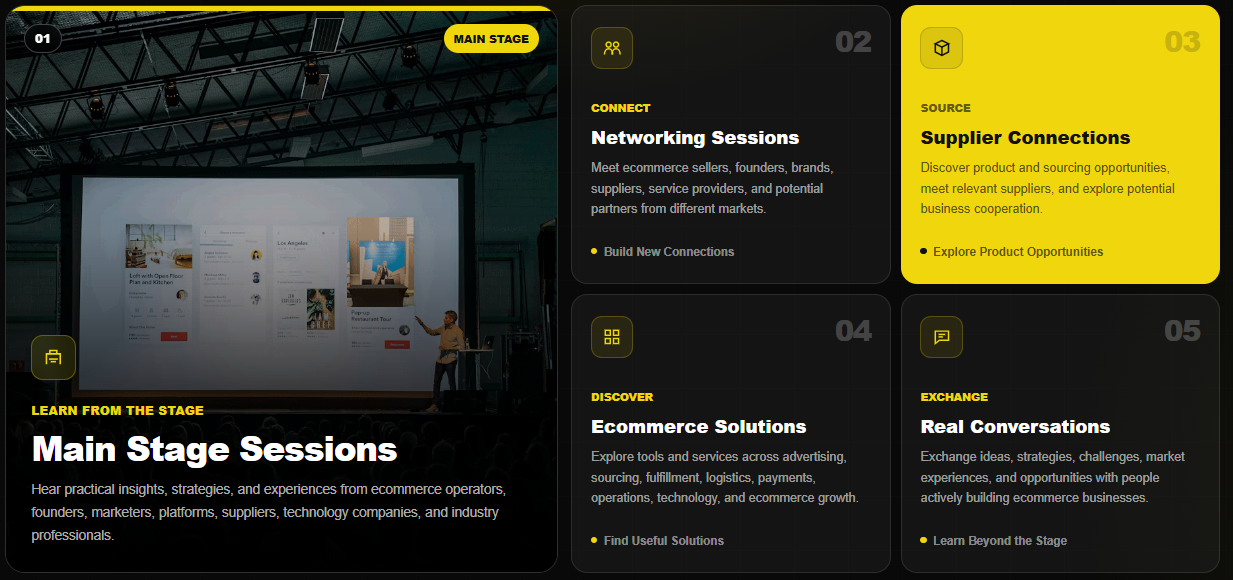
CJEC Bangkok is designed around networking sessions, supplier connections, e-commerce solutions and real conversations.
Attendees can meet:
- E-commerce sellers and brands
- Dropshipping entrepreneurs
- Suppliers and manufacturers
- Platforms and technology companies
- Marketing and creative partners
- Logistics and fulfillment providers
- Payment and SaaS companies
- CJdropshipping team members
The process is simple:
Meet → Connect → Share → Network.
Start a conversation.
Find common ground.
Exchange what you are working on.
Then explore whether there is a reason to stay connected.
The goal is not to collect as many contacts as possible.
The goal is to find the contacts that matter.
Who Should Attend CJEC Bangkok?
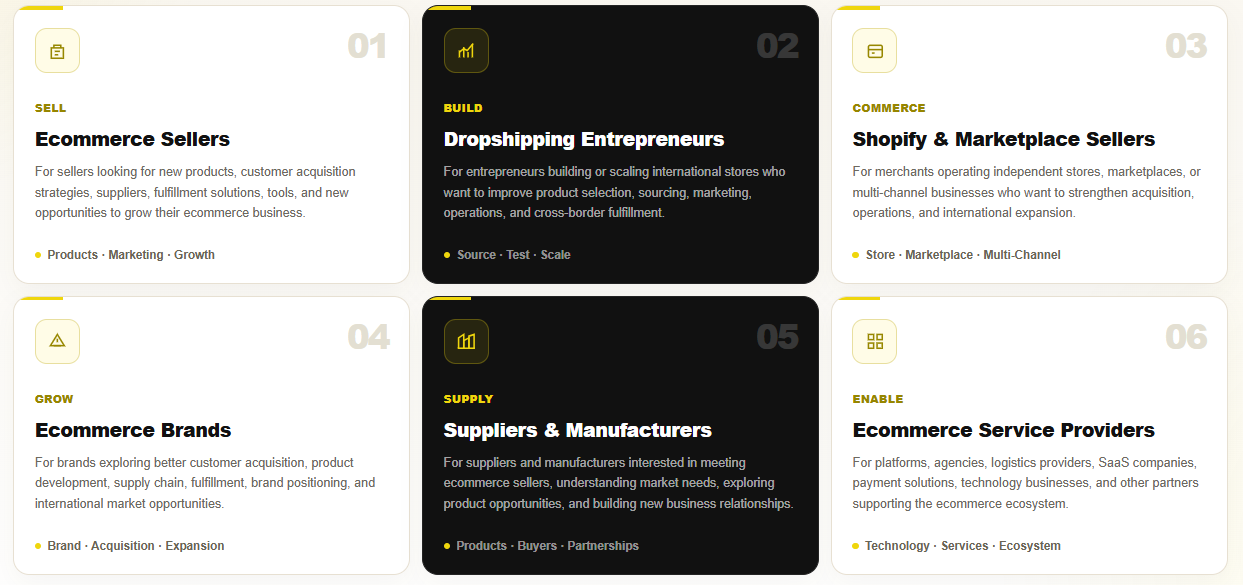
CJEC Bangkok is designed for the wider e-commerce ecosystem.
The official event page identifies six key groups: e-commerce sellers, dropshipping entrepreneurs, Shopify and marketplace sellers, e-commerce brands, suppliers and manufacturers, and e-commerce service providers.
You may be launching your first store.
You may already operate across several marketplaces.
You may be building a DTC brand.
You may manufacture products.
You may provide software, marketing, logistics or payment services.
There is value in bringing these different groups together because they depend on one another.
E-commerce is not one industry.
It is an ecosystem.
Choose Your CJEC Bangkok Pass
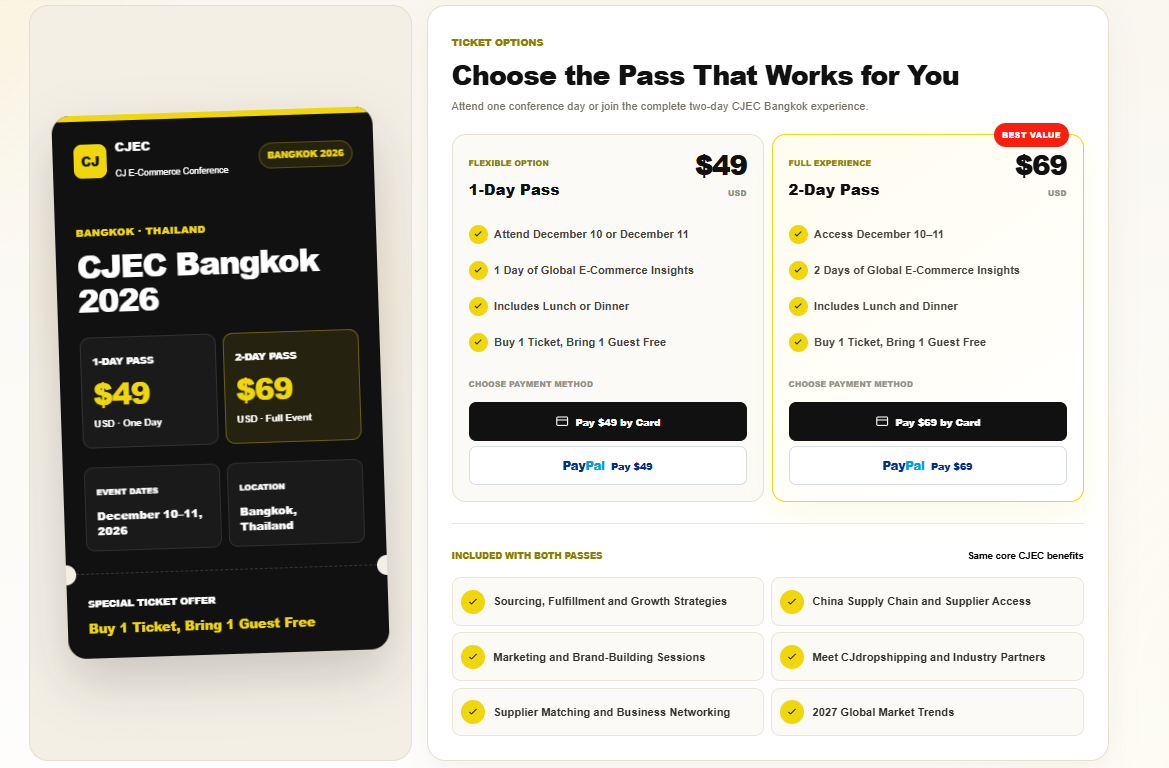
We created two ticket options so attendees can choose the experience that fits their schedule.
The 1-Day Pass costs $49 USD and gives you access to either December 10 or December 11. It includes one day of global e-commerce insights and lunch or dinner.
The 2-Day Pass costs $69 USD and gives you full access to both December 10 and December 11, including two days of sessions and lunch and dinner.
Both ticket types currently include:
- Sourcing, fulfillment and growth strategies
- China supply-chain and supplier access
- Marketing and brand-building sessions
- Access to CJdropshipping and industry partners
- Supplier matching and business networking
- Perspectives on 2027 global market trends
- Buy 1 Ticket, Bring 1 Guest Free
How to Prepare for CJEC Bangkok
Do not arrive with only one goal: “networking.”
Make it more specific.
Before the conference, identify your biggest business challenge.
Maybe you need better products.
Maybe your advertising costs are rising.
Maybe you want to enter Southeast Asia.
Maybe your current supplier cannot scale.
Maybe shipping is too slow.
Maybe you want to use AI more effectively.
Maybe your store generates sales but has not become a recognizable brand.
Now turn that problem into a question.
Instead of introducing yourself with:
“I do e-commerce.”
Say:
“We currently run a Shopify store selling in the U.S. and Europe, and we're exploring Southeast Asia. We're looking for better regional insights and a fulfillment strategy that can support expansion.”
Immediately, the conversation becomes more useful.
Meet Us in Bangkok
We are ending 2026 in a city that reflects where e-commerce is heading.
Global, but increasingly regional.
Digital, but driven by human relationships.
Powered by technology, but still dependent on products, suppliers and logistics.
Competitive, but full of new opportunities.
CJEC Bangkok brings all of these conversations together.
For two days, we want sellers, founders, brands, suppliers, creators, platforms and industry partners to learn from one another and explore what comes next.
Come to understand Southeast Asia.
Come to learn how AI is changing e-commerce.
Come to improve customer acquisition.
Come to discover products.
Come to meet suppliers.
Come to discuss fulfillment.
Come to build partnerships.
And most importantly, come ready to have conversations that continue long after the conference ends.
CJEC Bangkok 2026
December 10–11, 2026
Bangkok, Thailand
1-Day Pass: $49
2-Day Pass: $69
Buy 1 Ticket. Bring 1 Guest Free.
Where Global E-Commerce Meets Southeast Asia.