
Running a dropshipping store becomes complicated surprisingly quickly.
At the beginning, you may only need a product, a storefront, and a supplier willing to ship directly to customers. Once orders start arriving, however, the job expands. You have to monitor inventory, track supplier price changes, process orders, upload tracking numbers, respond to delivery questions, and make sure your margins still make sense.
Dropshipping platforms such as Spocket and AutoDS are designed to reduce some of this work. Both help sellers find products and manage their stores, but they solve different problems.
Spocket is best known as a supplier marketplace with a strong focus on products supplied from the United States and Europe. AutoDS is primarily an automation platform that helps sellers import, monitor, price, and fulfill products from multiple supported suppliers.
That difference matters.
Spocket may be more appealing when your priority is finding regional suppliers and managing a relatively focused product catalog. AutoDS may be better when your main goal is automating a large number of listings across one or more sales channels.
Neither platform, however, automatically solves every sourcing and fulfillment challenge. As a store moves toward custom packaging, product inspection, bulk inventory, or private-label development, sellers may need a more supply-chain-focused partner such as CJdropshipping.
This comparison looks at what Spocket and AutoDS actually offer, how much they cost, where each platform performs well, and when a sourcing and fulfillment platform may be the more practical option.
Pricing note: The prices in this comparison were checked in June 2026. SaaS plans, trials, add-ons, and promotional offers can change, so always confirm the final amount before subscribing.
Spocket vs AutoDS at a Glance
Spocket and AutoDS overlap in areas such as product importing, inventory management, and order processing. Their core models are still different.
Spocket starts with suppliers. It gives sellers a marketplace where they can search for products, review supplier details, import listings, and process customer orders.
AutoDS starts with automation. It connects a seller’s store with multiple product sources and provides tools for product importing, pricing rules, stock monitoring, order management, tracking, and research.
Here is the broad comparison:
| Category | Spocket | AutoDS |
|---|---|---|
| Core purpose | Supplier marketplace and product management | Dropshipping automation and multi-store management |
| Best known for | US and EU supplier products | Advanced automation and broad supplier support |
| Product discovery | Curated catalog, winning products, supplier filters | Marketplace, product research, trending products, ad research |
| Product importing | Simple one-click importing | One-click and bulk importing |
| Price monitoring | Included in the platform workflow | Available on qualifying plans |
| Order automation | Supplier-based order management and fulfillment | Automatic order processing and tracking workflows |
| Branding | Branded invoices and selected POD options | Selected branding and POD features |
| Integrations | Shopify, WooCommerce, Wix, BigCommerce, Squarespace and others | Shopify, eBay, Amazon, WooCommerce, Wix, Etsy, Facebook and TikTok Shop |
| Learning curve | Easier | More complex |
| Best fit | Smaller stores prioritizing regional suppliers | Sellers managing larger catalogs or multiple channels |
| Main limitation | Subscription cost and supplier-dependent margins | Add-on costs and reliance on third-party suppliers |
Spocket officially promotes access to US, EU, and global suppliers, along with a large catalog, product sourcing tools, automation, and print-on-demand options. AutoDS presents a broader automation suite that includes product importing, inventory management, price and stock monitoring, automated orders, tracking updates, product research, and AI-assisted store tools.
Choose Spocket if:
- You want to search specifically for products from US or European suppliers.
- You prefer a simpler marketplace-style workflow.
- You plan to manage a smaller, more focused product range.
- Branded invoices are useful to your customer experience.
- You do not need the deepest level of automation.
Choose AutoDS if:
- You want to import from several supported suppliers.
- You manage a large number of products.
- You sell through multiple ecommerce platforms or marketplaces.
- Automated pricing, stock monitoring, ordering, and tracking are priorities.
- You are comfortable configuring a more detailed system.
Consider CJdropshipping if:
- You want one company to be more directly involved in sourcing and fulfillment.
- You need product inspection before shipping.
- You want custom packaging, product photography, POD, or ODM support.
- You plan to stock successful products in a warehouse.
- You want to move from product testing toward a more controlled supply chain.
What Is Spocket?
Spocket is a dropshipping supplier marketplace and store-management platform. Its strongest positioning is access to products from suppliers located in the US and Europe, although its catalog also includes suppliers and products from other regions.
The platform allows a seller to connect an ecommerce store, search for products, review basic supplier and shipping information, import listings, set retail prices, and forward orders for fulfillment.
Spocket currently lists integrations with platforms and channels including Shopify, BigCommerce, Wix, WooCommerce, Squarespace, Ecwid, Square, Amazon, eBay, Alibaba, and AliExpress.
How Spocket Works
A typical Spocket workflow looks like this:
- Create an account and choose a subscription.
- Connect your ecommerce store.
- Search Spocket’s product catalog.
- Filter products by category, shipping origin, destination, price, or supplier.
- Add products to your import list.
- Edit the title, description, images, variants, and price.
- Publish the product to your store.
- When a customer places an order, process it through Spocket.
- The supplier packs and ships the order.
- Tracking information is returned to the seller and customer.
This approach is relatively easy to understand. A beginner does not need to build direct supplier relationships before listing the first product.
Where Spocket Is Strong
Spocket’s biggest advantage is supplier discovery.
Many sellers want to reduce their dependence on long international shipping routes. Spocket makes it easier to filter for products located closer to customers in the US or Europe. That does not guarantee fast delivery for every order, but it gives sellers a more convenient way to identify regional options.
The platform also presents product and supplier information in a relatively approachable format. This makes it useful for store owners who do not want to manage dozens of external supplier websites.
Another recognizable Spocket feature is branded invoicing. Paid users can add information such as a logo and personalized message to invoices, although Spocket notes that branded invoices are not supported by every supplier.
Who Spocket Is Best For
Spocket generally makes the most sense for:
- New Shopify or WooCommerce store owners
- Sellers targeting customers in the US or Europe
- Stores with relatively small product catalogs
- Sellers who value simple product discovery
- Businesses that want regional supplier options without contacting suppliers individually
Its simplicity is part of its appeal. It is easier to understand than a platform built around dozens of automation rules.
The trade-off is that the seller has less control over the supply chain. Product quality, packaging, processing times, and delivery still depend on the supplier responsible for each listing.
What Is AutoDS?
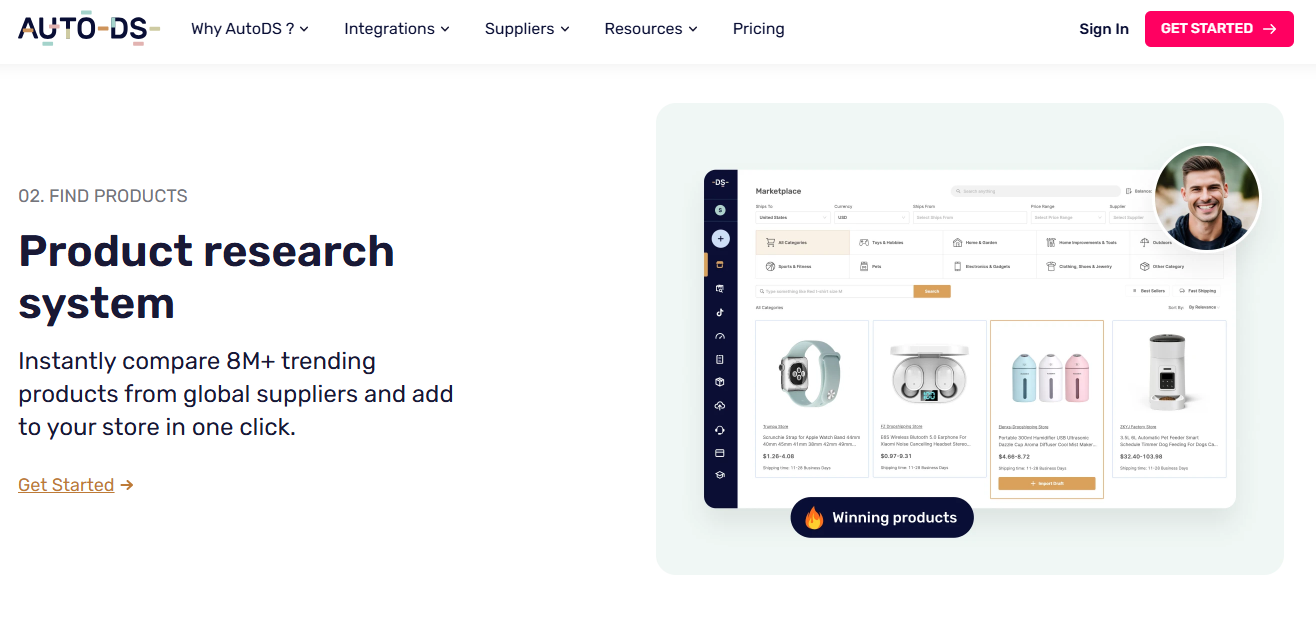
AutoDS is a dropshipping automation platform. Rather than acting only as one supplier marketplace, it helps sellers import and manage products from multiple supported suppliers and sales channels.
Its current feature set includes product research, a product marketplace, one-click importing, bulk importing, inventory management, price and stock monitoring, automatic price optimization, automated order processing, tracking updates, print on demand, and AI tools for store and product-page creation.
AutoDS supports a broader range of selling channels than many basic dropshipping apps. Its official site currently lists Shopify, Facebook, Etsy, WooCommerce, eBay, Amazon, Wix, and TikTok Shop.
How AutoDS Works
A typical workflow is:
- Choose your selling channel and subscription plan.
- Connect your store or marketplace account.
- Find products through the AutoDS Marketplace, product-research tools, or supported suppliers.
- Import products individually or in bulk.
- Edit product information and variants.
- Configure pricing, profit, shipping, and stock rules.
- Activate monitoring features supported by your plan.
- Manage customer orders through the AutoDS dashboard.
- Use automatic ordering or Fulfilled by AutoDS when supported.
- Sync tracking information back to the selling channel.
The setup requires more decisions than Spocket. Sellers need to understand pricing rules, supplier settings, monitoring, and order automation before relying heavily on the platform.
That additional complexity comes with more control.
Where AutoDS Is Strong
AutoDS is strongest when a seller has repetitive operational work to automate.
For example, a supplier may change a product price after the seller has already published the listing. If the store price remains unchanged, the seller’s profit may disappear. AutoDS provides pricing and monitoring tools designed to update listings according to predefined rules.
It can also monitor stock availability and change a product’s store status when the source supplier runs out. AutoDS states that its monitoring system scans products multiple times per day when the feature is enabled.
Order automation is another major advantage. AutoDS offers automated ordering, tracking updates, and Fulfilled by AutoDS workflows. Some of these functions require an eligible plan, a supported supplier, an account balance, or a separate add-on.
Who AutoDS Is Best For
AutoDS is usually a better fit for:
- Sellers managing hundreds of listings
- Marketplace sellers using eBay, Amazon, Etsy, or TikTok Shop
- Teams running multiple stores
- Sellers importing from several supplier sources
- Operators who want detailed pricing and inventory rules
- Experienced dropshippers trying to reduce manual work
It is less suitable for someone who expects software to solve supplier quality or fulfillment reliability automatically. AutoDS can automate the flow of data and orders, but the underlying product and delivery experience still depends heavily on the source supplier.
Spocket vs AutoDS: Features Compared
1. Product Selection and Supplier Network
Spocket
Spocket is built around a searchable supplier catalog. Its strongest appeal is the ability to look for products from US and EU suppliers alongside global options.
This can be useful when supplier location is central to your product strategy. A seller targeting American customers, for example, may filter for products shipping from a US location rather than sorting manually through overseas listings.
Spocket also supports AliExpress and Alibaba-related product workflows, so it is no longer limited to one narrow regional catalog. Its main branding, however, remains centered on US and European supplier access.
AutoDS
AutoDS supports a broader supplier model. Sellers can import products from supported retail suppliers, marketplaces, private suppliers, the AutoDS Marketplace, and sourcing services.
That flexibility is valuable when you want to compare different product sources or operate different store models. It also makes the platform more complicated because shipping methods, return procedures, packaging, stock behavior, and supplier policies can vary significantly.
Verdict
Spocket is better for focused regional supplier discovery.
AutoDS is better for supplier variety and multi-source product management.
For a small store selling 20 carefully selected products, Spocket’s model may feel cleaner. For a seller testing hundreds of listings from several sources, AutoDS provides more flexibility.
2. Product Research
Spocket includes a catalog, product filters, winning-product discovery, and related research tools. The experience is closely connected to its supplier marketplace, which means users can move from product discovery to importing without leaving the platform.
AutoDS provides a wider research ecosystem. It promotes marketplace products, hand-picked products, trending products, and advertising research tools for platforms such as TikTok, Facebook, and Instagram.
However, buyers should read the pricing details carefully. AutoDS’s Product Finding Hub is a separate paid add-on. The official help center says it includes hand-picked products, trending products, Ads Spy, and TikTok Analytics, with separate monthly or annual billing.
Verdict
AutoDS has the more advanced product-research toolkit.
Spocket is sufficient when you mainly want to browse products available from its supplier network. AutoDS is more useful when product research, ad research, and catalog management need to work together.
The value depends on whether you will use those research tools regularly. Paying for more data does not help much if you still choose products based only on attractive photos.
3. Product Importing and Editing
Both platforms allow sellers to import products and edit listing information before publishing.
Spocket’s workflow is more straightforward. You add a product to an import list, update its title, description, images, variants, and price, then publish it to your connected store.
AutoDS offers more advanced importing and editing features, including bulk importing, product management, image tools, AI-supported title and description editing, and supplier-based automation rules. Some advanced functions are limited to higher plans.
Verdict
Spocket is easier for small catalogs.
AutoDS is better for bulk importing and large-scale listing management.
If you plan to publish 10 to 30 products, the difference may not matter much. If you manage 500 listings, bulk tools become far more valuable.
4. Price and Stock Monitoring
Price and stock monitoring protects sellers from two common problems: selling a product that is no longer available and selling at a loss after a supplier raises its price.
Spocket states that it automatically monitors product prices and stock levels so connected stores can remain updated.
AutoDS offers more detailed monitoring and pricing settings. Sellers can configure profit margins, fees, dynamic pricing, shipping calculations, and other rules.
There is an important pricing distinction. AutoDS’s official help center says the Import Plan does not include price and stock monitoring, even though older or differently rendered pricing information may suggest otherwise. Sellers who need monitoring should confirm the selected plan before paying.
Verdict
AutoDS offers deeper pricing controls, but Spocket provides a simpler monitoring experience.
AutoDS wins when the correct plan is selected and the seller is willing to configure the system. Spocket is easier for someone who only wants basic updates without building detailed pricing formulas.
5. Order Fulfillment and Tracking
Spocket’s order flow is supplier-led. The seller processes the order through Spocket, and the relevant supplier packs and ships it. Tracking information is then made available through the platform.
Spocket says its order-management functions include tracking and automatic fulfillment, but the actual processing and delivery performance remain dependent on the supplier.
AutoDS offers several fulfillment approaches. Sellers may use automatic ordering with supported suppliers, manage orders through the dashboard, or use Fulfilled by AutoDS. The platform can also update tracking details automatically under supported workflows.
Its Auto Ordering System is currently listed as a separate add-on at $9.90 per month on the official pricing page. This is another reason to calculate the complete software cost rather than comparing only the base subscription.
Verdict
AutoDS provides more fulfillment automation.
Spocket provides the simpler order flow.
Neither result means every order will be trouble-free. Automation can place an order and transfer tracking data, but it cannot fully prevent damaged products, inaccurate descriptions, packaging problems, or courier delays.
6. Shipping Speed
It is tempting to say that Spocket always ships faster because of its US and EU supplier positioning. In reality, shipping performance depends on the individual listing.
A product may be supplied from the US but still require several days of processing. Another product may be shipped internationally through an efficient dedicated line. Warehouse location is important, but it is not the only variable.
Before listing a product, check:
- Where the inventory is physically stored
- How long the supplier needs to process an order
- Which shipping service is used
- Whether tracking is end-to-end
- The estimated delivery range
- Whether remote areas require more time
- The supplier’s performance during peak seasons
Spocket makes regional supplier filtering more convenient. AutoDS gives sellers access to more supplier types, so shipping speed varies more widely.
Verdict
Spocket has the advantage when finding local US and EU supplier options.
There is no universal winner for actual delivery speed. That must be evaluated product by product.
7. Product Quality and Inspection
This is one of the most important limitations in the Spocket versus AutoDS comparison.
Both platforms can make it easier to find and manage products. Neither software interface should be treated as a replacement for product testing.
Before scaling a product, sellers should order samples, inspect the item, test its packaging, verify instructions, compare the received product with the listing, and measure real delivery time.
AutoDS may source from a range of third-party suppliers. Spocket products are also fulfilled by individual suppliers in its network. Quality can therefore vary across listings on either platform.
Verdict
Neither platform wins automatically on quality control.
The individual supplier matters more than the software.
This is also where a direct sourcing and fulfillment platform starts to become relevant. A seller who wants goods inspected before dispatch may prefer working with a company that physically handles the product rather than only transferring order information.
8. Branding and Customization
Spocket offers branded invoices, allowing eligible sellers to add a logo, contact information, and a personalized message. This gives the package a more professional touch, although the feature is not available from every supplier.
Spocket also promotes print-on-demand and customization options. The exact level of customization depends on the supplier and product.
AutoDS offers POD and selected custom-branding functions. Its pricing materials describe logo branding for orders from supported suppliers, although availability depends on the relevant supplier and workflow.
A branded invoice is useful, but it is not the same as a complete branded product experience. Sellers building a serious brand may eventually need:
- Custom product packaging
- Branded boxes or mailers
- Product labels
- Instruction cards
- Thank-you inserts
- Bundle assembly
- Modified product features
- Quality standards agreed with a factory
- Consistent fulfillment from one warehouse
Verdict
Spocket is useful for branded invoicing.
AutoDS offers selected branding and POD tools.
Neither should automatically be viewed as a complete private-label supply-chain solution.
9. Ecommerce Integrations
Spocket’s official integrations page lists Shopify, BigCommerce, Wix, Ecwid, Squarespace, WooCommerce, Square, Alibaba, AliExpress, Amazon, and eBay.
AutoDS supports Shopify, Facebook, Etsy, WooCommerce, eBay, Amazon, Wix, and TikTok Shop.
The practical difference is that AutoDS is more heavily designed around multi-channel operations. It gives sellers a central dashboard for products, orders, and automation across supported platforms.
Spocket works well for independent ecommerce stores and has expanded its channel coverage, but its core experience still feels closer to a supplier marketplace connected to a store.
Verdict
AutoDS is the stronger option for multi-channel sellers.
Spocket remains a solid choice for a seller managing one primary storefront.
10. Ease of Use
Spocket is easier to understand.
The platform follows a familiar sequence: search, import, publish, sell, and process the order. A beginner can learn the basic workflow without spending much time on automation settings.
AutoDS has a longer learning curve because it does more. Sellers need to understand product monitoring, supplier settings, pricing rules, order methods, add-ons, plan limitations, and channel-specific configurations.
The question is not which interface looks simpler. The question is how much operational complexity your business has.
A small store does not need an enterprise-style control panel. A large catalog cannot be managed efficiently through a system built only for simple product importing.
Verdict
Spocket wins for simplicity.
AutoDS wins for operational depth.
Spocket vs AutoDS Pricing
Spocket Pricing
Spocket currently displays four main monthly plans.
| Plan | Monthly Price | Product Allowance |
|---|---|---|
| Starter | $39.99 | 25 unique products |
| Professional | $59.99 | 250 unique products and 25 premium products |
| Empire | $99.99 | 10,000 unique products and 10,000 premium products |
| Unicorn | $299.99 | 25,000 unique products and 25,000 premium products |
Spocket currently advertises a seven-day trial. Its paid plans include features such as zero platform transaction fees, unlimited orders, supplier chat, branded invoices, and bulk checkout, with product limits varying by plan. A separate subscription may be required for each connected store to receive full plan features.
The Starter plan may be enough to learn the platform, but its 25-product limit can feel restrictive. For a serious general store or a seller testing many products, Professional is a more realistic entry point.
The subscription is also only one part of the cost. Sellers still have to pay for:
- Product cost
- Supplier shipping
- Ecommerce platform fees
- Payment-processing fees
- Advertising
- Samples
- Returns and refunds
- Other store apps
AutoDS Pricing
AutoDS pricing varies by selling channel. For a standard Shopify plan, the currently published options include:
| Plan | Monthly Billing | Annual Effective Rate | Product Variation Limit |
|---|---|---|---|
| Import | $26.90/month | $19.90/month | 200 |
| Starter | $39.90/month | $29.90/month | 500 |
| Advanced | $66.90/month | $49.90/month | 1,000 |
| Enterprise | Custom | Custom | Above 1,000 |
AutoDS offers a three-day trial for approximately $1. The exact subscription price and product limit can vary by selling channel, and Amazon plans may cost more than comparable Shopify, eBay, WooCommerce, or TikTok Shop plans.
The Import plan is the lowest-cost option, but its official help documentation states that price and stock monitoring is not included. The Starter plan is more representative of the automation experience many sellers expect from AutoDS.
Potential add-on costs include:
| AutoDS Add-on | Listed Monthly Price |
|---|---|
| Auto Ordering System | $9.90 |
| VA Access | $14.97 |
| Product Finding Hub | $14.97 |
| Mentor | $39.97 |
The Product Finding Hub is also available on an annual arrangement at a lower effective monthly rate, according to AutoDS’s help documentation.
Which Platform Offers Better Value?
AutoDS generally provides more software functionality for the price, especially when a seller uses automation to manage a large catalog.
However, the base subscription can be misleading. A seller who needs the Starter plan, Product Finding Hub, and automatic ordering will pay considerably more than the headline entry price.
Spocket costs more at the entry level, but the workflow may be easier to understand. It can provide reasonable value for a store that needs only a carefully selected group of products from regional suppliers.
The better value depends on the cost of the problem being solved.
If automation saves ten hours per week, AutoDS may easily justify its subscription. If you only sell eight products, much of that functionality may be unnecessary.
If a Spocket supplier offers a good product with reliable domestic delivery, the subscription may be worthwhile. If the product price is too high to leave a healthy advertising margin, regional sourcing alone does not make the business viable.
Spocket Pros and Cons
Spocket Pros
- Strong focus on US and European supplier options
- Straightforward product-search experience
- Beginner-friendly workflow
- One-click product importing
- Automatic price and stock monitoring
- Branded invoices
- Supplier communication
- Multiple ecommerce integrations
- Unlimited orders on listed paid plans
- Useful shipping-location filters
- Print-on-demand options
Spocket Cons
- Relatively high entry-level subscription
- Only 25 unique products on the Starter plan
- Premium product limits on lower plans
- Product costs may leave limited advertising margins
- Supplier performance can vary
- Branded invoicing is not available from every supplier
- Custom packaging and private labeling depend on supplier capabilities
- Each store may require a separate subscription
- Less advanced automation than AutoDS
AutoDS Pros and Cons
AutoDS Pros
- Advanced product and order automation
- Broad supplier compatibility
- Strong bulk-importing capabilities
- Detailed pricing rules
- Inventory and stock management
- Automatic tracking updates
- Multi-channel integrations
- Product and advertising research tools
- AI-assisted listing and store functions
- Better suited to large catalogs
- Support for multiple stores on higher plans
- Fulfilled by AutoDS option
AutoDS Cons
- More complicated for beginners
- Important features may require an upgraded plan
- Some tools are paid add-ons
- Pricing varies by selling channel
- Automatic ordering may cost extra
- Product quality still depends on the supplier
- Retail suppliers can change stock, prices, and policies
- Supplier packaging may not match your brand
- Automation still requires regular supervision
- AutoDS often acts as the management layer rather than the physical fulfillment provider
Which Platform Is Better for Different Sellers?
Best for Complete Beginners: Spocket
Spocket is easier for a beginner to understand. The catalog is central to the experience, and the workflow from searching to importing is relatively direct.
A new seller can focus on learning product selection, store design, pricing, advertising, and customer support without configuring too many operational rules.
The downside is the cost. Paying $39.99 per month for a 25-product limit may feel expensive before the store has generated reliable sales.
Best for Automation: AutoDS
AutoDS is the clear winner for automation.
Its product importing, pricing rules, inventory management, order workflows, and tracking tools are designed to reduce repetitive work. This becomes especially valuable when a store grows beyond what can be managed manually.
The platform only saves time when it is configured properly. Sellers should not activate every feature without understanding how supplier prices, shipping charges, taxes, and profit settings are calculated.
Best for US and EU Supplier Discovery: Spocket
Spocket’s regional supplier focus is its most obvious advantage.
It gives sellers a convenient way to search for products that may be stocked closer to customers in Western markets. This can help reduce shipping distance and make delivery expectations easier to manage.
You still need to check each product’s processing and estimated delivery time. “US supplier” does not always mean next-day dispatch.
Best for Large Product Catalogs: AutoDS
AutoDS is better for stores managing hundreds or thousands of product variations.
Bulk imports, monitoring, automated price changes, product editing, and centralized order management become increasingly valuable as catalog size grows.
Spocket’s lower plans are more appropriate for a focused product selection.
Best for Marketplace Sellers: AutoDS
Sellers operating on eBay, Amazon, Etsy, Facebook, or TikTok Shop are more likely to benefit from AutoDS.
Its multi-channel structure is better suited to businesses that need to manage listings and orders across several marketplaces.
Before using any dropshipping tool on a marketplace, sellers should still review the marketplace’s own dropshipping, seller-of-record, delivery, and customer-service rules.
Best for Branded Invoices: Spocket
Spocket’s branded invoicing is simple and practical. Adding your logo and a short message is better than sending a completely generic supplier document.
However, an invoice is only one part of branding. Customers are more likely to remember the product, packaging, delivery experience, and customer service than the invoice alone.
Best for Building a Private Brand: Neither Is Fully Complete
Spocket and AutoDS can both support early-stage branding. Spocket offers branded invoicing and POD options, while AutoDS offers selected logo and POD tools.
A private brand normally requires more direct control over:
- Factory selection
- Product specifications
- Samples
- Quality standards
- Packaging materials
- Labels
- Inventory
- Fulfillment
- Replacement procedures
At that stage, sellers often need more than a product-importing or automation platform.
Is CJdropshipping a Better Alternative?
CJdropshipping does not fit perfectly into the same category as Spocket or AutoDS.
Spocket is primarily a supplier marketplace. AutoDS is primarily an automation platform. CJdropshipping combines platform tools with sourcing, physical order fulfillment, warehousing, quality inspection, custom packaging, print on demand, bulk purchasing, and 3PL services.
CJ’s normal dropshipping workflow includes sourcing or selecting a product, connecting a store, syncing orders, paying for fulfillment, and tracking shipments. It also promotes global warehouses, custom packaging, ODM, POD, bulk purchasing, and 3PL fulfillment.
That difference becomes important when the main problem is no longer listing automation.
A seller may already have a product that converts well. What they need next is a better purchase price, more consistent packaging, inspection before shipping, or inventory placed closer to customers.
Those are supply-chain problems.
Spocket vs AutoDS vs CJdropshipping
| Category | Spocket | AutoDS | CJdropshipping |
|---|---|---|---|
| Main role | Supplier marketplace | Automation software | Sourcing and fulfillment platform |
| Standard platform fee | Paid subscription | Paid subscription and optional add-ons | No standard setup or monthly fee for basic use |
| Product sourcing | Existing supplier catalog | Supported suppliers and sourcing tools | Catalog plus sourcing requests |
| Automation | Moderate | Advanced | Store, order, and tracking integration |
| Physical fulfillment | Handled by individual suppliers | Supplier or supported AutoDS workflow | Handled through CJ’s fulfillment network |
| Quality inspection | Supplier-dependent | Supplier-dependent | Inspection before packing is offered |
| Custom packaging | Depends on supplier | Selected options | Dedicated custom-packaging service |
| POD | Available | Available | Available |
| Warehousing | Supplier-dependent | Supplier and partner-dependent | Global warehouse and 3PL options |
| Bulk inventory | Limited by supplier relationship | Depends on source | Supported |
| Best fit | Regional product discovery | Automation-heavy operations | Sellers seeking supply-chain control |
CJ’s official service page states that the platform has no setup fee, no standard monthly fee, no minimum order requirement, and no standard storage fee under its published basic service model. Sellers pay for products, shipping, and any applicable optional or fulfillment services rather than a mandatory software subscription.
Why CJdropshipping May Be More Practical for Product Testing
A beginner usually wants to keep fixed costs low.
With Spocket or AutoDS, the subscription starts before the store has necessarily generated a sale. The seller must then pay for the store, domain, advertising tools, creative production, and other apps.
CJdropshipping’s basic access model avoids a standard monthly platform charge. This does not make fulfillment free. Sellers still pay for the product and shipping, but the cost is tied more directly to actual sourcing and order activity.
For someone testing a small number of products, that can be more efficient than paying monthly for software features that are not yet being fully used.
Why CJdropshipping May Be Better for Sourcing
Spocket is convenient when a suitable product already exists in its marketplace. AutoDS is useful when the product can be imported from a supported source.
But winning-product research often begins outside a supplier platform. A seller may find a product in a competitor’s advertisement, a social video, an offline market, or a manufacturer’s catalog.
CJ allows users to submit sourcing requests when the desired product is not already available. Its published service information says the sourcing team reviews requests and looks for the requested product, connecting the seller more directly with the procurement process.
This becomes useful when you need:
- A different product specification
- A more competitive supplier
- A specific color or variation
- More stable stock
- A factory quote
- Packaging changes
- Bulk inventory
Why Physical Quality Inspection Matters
Software can monitor whether a supplier page says “in stock.” It cannot see whether the item inside the package is scratched, incorrectly colored, badly assembled, or missing a component.
CJ states that products are inspected before packing as part of its fulfillment process. It also provides dedicated quality-inspection and 3PL services for sellers stocking products through CJ.
No inspection system eliminates every possible defect. Still, having the fulfillment provider physically handle and check products creates a different level of oversight from simply forwarding an order to an unrelated supplier.
Why CJdropshipping Is Better Positioned for Brand Growth
Spocket’s branded invoices are useful at the beginning. AutoDS’s automation is useful as order volume grows.
A store moving toward a recognizable brand usually needs more.
CJ supports custom packaging, POD, ODM, bulk purchasing, and warehouse fulfillment. That creates a more natural path from testing a generic product to stocking a customized version.
A seller might begin by fulfilling products individually. Once the product is validated, they can purchase inventory, reduce processing uncertainty, add branded packaging, and stock goods in a suitable warehouse.
This does not mean CJdropshipping is automatically best for every seller. AutoDS still offers deeper automation for businesses managing products from many retail suppliers. Spocket still gives sellers a focused way to browse US and European supplier products.
CJ is strongest when the seller wants the sourcing and fulfillment process to become more connected.
Final Verdict
Spocket and AutoDS are both useful, but they are built for different types of sellers.
Choose Spocket if you value simplicity and regional suppliers
Spocket is a good option for a smaller independent store that wants an approachable supplier marketplace. Its focus on US and European suppliers, simple importing workflow, automatic monitoring, and branded invoicing make it easy to understand.
The main concerns are subscription cost, lower-plan product limits, and the fact that prices and service quality still depend on individual suppliers.
Choose AutoDS if automation is your priority
AutoDS is the stronger platform for managing a large number of products, suppliers, stores, or selling channels.
Its bulk importing, pricing rules, inventory monitoring, automatic ordering, tracking, and research features can remove a large amount of manual work.
The main drawbacks are complexity and total cost. The lowest subscription does not include every automation feature, and tools such as automatic ordering and the Product Finding Hub can add to the monthly bill.
Choose CJdropshipping if sourcing and fulfillment matter more than software alone
CJdropshipping is a practical alternative for sellers who want support beyond importing and monitoring listings.
It brings product sourcing, store connection, fulfillment, inspection, shipping, warehousing, POD, custom packaging, and bulk purchasing into one supply-chain ecosystem. Basic access does not require the same kind of fixed monthly SaaS subscription, which can also make it more practical during early product testing.
The final result is not that Spocket or AutoDS is universally better.
- Spocket is best for straightforward regional supplier discovery.
- AutoDS is best for advanced automation and multi-channel management.
- CJdropshipping is the more complete option when the seller needs sourcing, physical fulfillment, and a path toward branding.
For a small store selling selected US or European products, Spocket can be a sensible choice. For an experienced operator managing hundreds of listings, AutoDS may save more time.
For a seller who wants to test products without adding another large recurring software cost, then gradually improve sourcing, inspection, packaging, inventory, and fulfillment, CJdropshipping offers the most balanced route.
Frequently Asked Questions
Is AutoDS better than Spocket?
AutoDS is better for advanced automation, bulk product management, pricing rules, inventory monitoring, and multi-channel selling. Spocket is better for sellers who prefer a simpler interface and want easier access to products from US and European suppliers.
Is Spocket cheaper than AutoDS?
No. Spocket’s Starter plan is currently $39.99 per month, while AutoDS’s Shopify Import plan starts at $26.90 monthly or $19.90 per month with annual billing. However, the AutoDS Import plan does not include price and stock monitoring, and separate add-ons can increase the total cost.
What is the best alternative to Spocket and AutoDS?
CJdropshipping is a strong alternative for sellers who need actual sourcing and fulfillment support rather than mainly a supplier directory or software automation layer.
It is especially relevant for product sourcing requests, quality inspection, global shipping, warehouse fulfillment, custom packaging, POD, bulk inventory, and gradual brand development.